Shangri-La is a web-based interface for medical case-based retrieval.
The web interface can be accessed in the link http://shangrila.khresmoi.eu/

Content-Based Image Retrieval
Shangri-La is a web-based interface for medical case-based retrieval.
The web interface can be accessed in the link http://shangrila.khresmoi.eu/
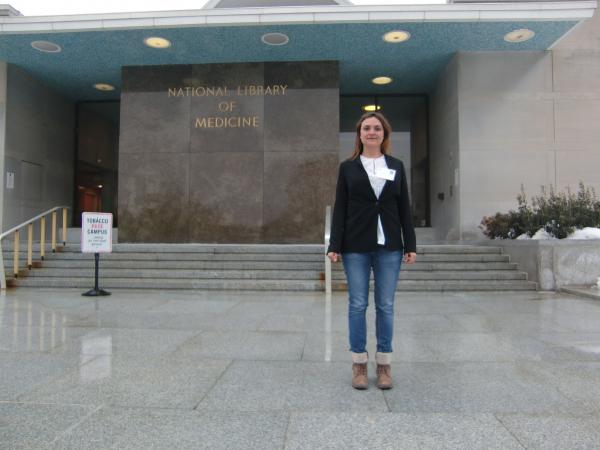
Alba García Seco de Herrera presented her PhD work at the National Library of Medicine, in Bethesda, United States. Her thesis’ title is ‘Use-Case Oriented Medical Visual Information Retrieval & System Evaluation’.
She will present her thesis defence in April 2015.
The paper ‘Applying Machine Learning to Gait Analysis Data for Disease Identification’ by Ranveer Joyseeree et al. has been accepted for a presentation at Medical Informatics Europe (MIE) 2015.
The MIE 2015 will take place 27-29th May 2015 in Madrid, Spain.
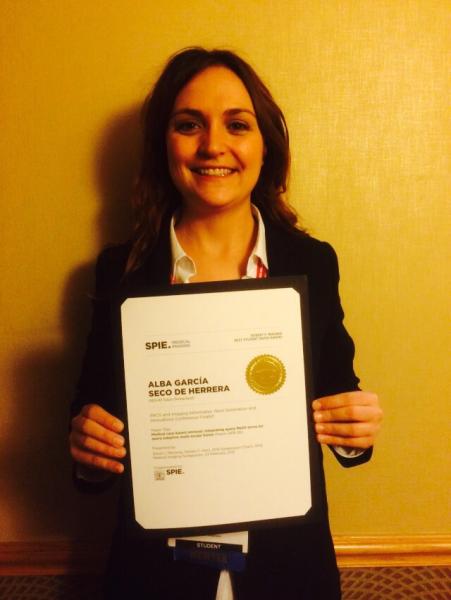
The paper ‘Medical case-based retrieval: integrating query MeSH terms for query-adaptive multi-modal fusion’ by Alba García Seco de Herrera et al. was among the finalists for the Robert F. Wagner Best Student Paper Award.
The award was given during the SPIE 2015 Medical Imaging Conference for the best paper in the category PACS and Imaging Informatics: Next Generation and Innovations
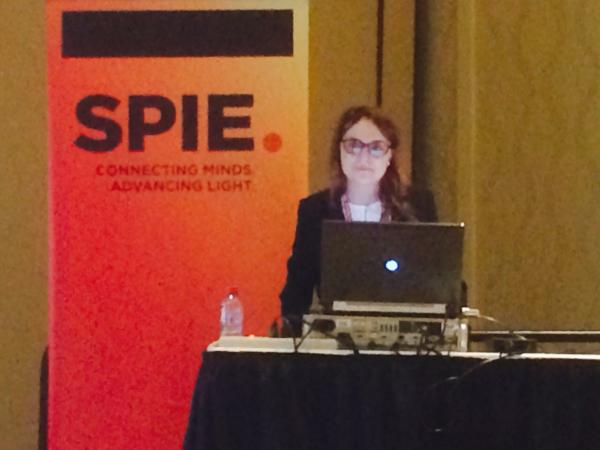
Three oral presentations and a poster paper were presented at the SPIE Medical Imaging Conference 2015 in Orlando, Florida, United States.
The presented papers are:
Alba García Seco de Herrera et al. ‘Medical case-based retrieval: integrating query MeSH terms for query-adaptive multi-modal fusion’
Oscar Jiménez et al. ‘Texture classification of anatomical structures using a context-free machine learning approach’
Ranveer Joyseeree et al. ‘Locating seed points for automatic multi-organ segmentation using non-rigid registration and organ annotations’
Yashin Dicente Cid et al. ‘Pulmonary Embolism Detection using Localized Vessel-Based Features in Dual Energy CT’
These and other publications can be found in our publication webpage.
Prof. Henning Müller, Prof. Adrien Depeursinge and PhD Manfredo Atzori visited Idiap Research Institute at Martigny, Switzerland.
The oral presentation titled Medical visual information retrieval: techniques and evaluation can be seen at the Idiap website.
The publication ‘Electromyography data for non-invasive naturally-controlled robotic hand prostheses’ by Manfredo Atzori et al. has now been published. This research was conducted as part of the NinaPro project.
Both the data and the article can be found at the open-access Scientific Data publication from Nature.com.
Prof. Hening Müller participated as an invited speaker in the Forum for Information Retrieval Evaluation (FIRE) 2014 at the Indian Statistical Institute in Bangalore.
Here is the forum’s objective:
The importance of reusable, large-scale standard test collections in Information Access research has been widely recognized. The success of TREC, CLEF, and NTCIR has clearly established the importance of an evaluation workshop that facilitates research by providing the data and a common forum for comparing models and techniques. The Forum for Information Retrieval Evaluation (FIRE) follows in the footsteps of TREC, CLEF and NTCIR with the following aims:
An article about the VISCERAL project appeared in Research*EU magazine. The publication is available in the Issue 38 – December 2014/ January 2015.
The PhD defence of Dimitrios Markonis thesis took place 19th November, 2014. The thesis is titled: ‘User-oriented Medical Image Retrieval’.
Dimitrios’ publications can be found here.
Four papers from the MedGIFT group have been accepted to be presented at the next SPIE Medical Imaging 2015 conference in Orlando, United States. The conference will take place from the 21-26 February 2015.
The accepted papers are:
The page http://khresmoi.atosresearch.eu gives an overview of the components and prototypes developed in the Khresmoi project, with the possibility to request information on their further use.
The Khresmoi project final review received a grade of “excellent”.
The page http://partners.khresmoi.eu gives an overview of the components and prototypes developed in the Khresmoi project, with the possibility to request information on their further use.
The paper ‘Evaluation of a Hierarchical Anatomic Segmentation Approach in VISCERAL Anatomy Benchmarks’ will be presented at the MICCAI Workshop on Medical Computer Vision: Algorithms for Big Data (bigMCV).
The paper was written by Oscar Jimenez and Henning Müller who will make the presentation next 18 sept. 2014 at MIT, Boston USA.
KHRESMOI has appeared in DiarioMedico.com. They made an interview to Blanca Jordan Rodríguez that has been published in their website:
http://www.diariomedico.com/2011/01/10/area-profesional/gestion/khresmoi-informacion-para-todos
The interview is related to the project and it’s exploitation with comments on the future plans and monetization.
For more information about the KHRESMOI project go to http://www.khresmoi.eu/
The PhD defence of Antonio Foncubierta thesis took place 4th September, 2014. The thesis is titled: ‘Description and retrieval of medical visual information based on language modelling’.
Antonio’s publications can be found here.
The US National Cancer Institute recently accepted the C-BIBOP project . Our group at the HES-SO is external contractor of the project that is about creating a cloud-based platform for biomarker optimization.
Lead partner is Harvard University with other partners being Stanford University, Columbia University and the Moffitt cancer Research Center.
Since September 1st 2014, Adrien Depeursinge is working as a professor at the HES-SO Valais.
His publications can be found here.
The paper ‘Three-dimensional solid texture analysis in biomedical imaging: Review and opportunities’ by Adrien Depeursinge et al. is among the Top 25 Hottest Articles from the Medical Image Analysis journal for the first quarter of 2014.
A b s t r a c t
Three-dimensional computerized characterization of biomedical solid textures is key to large-scale and high-throughput screening of imaging data. Such data increasingly become available in the clinical and research environments with an ever increasing spatial resolution. In this text we exhaustively analyze the state-of-the-art in 3-D biomedical texture analysis to identify the specific needs of the application domains and extract promising trends in image processing algorithms. The geometrical properties of biomedical textures are studied both in their natural space and on digitized lattices. It is found that most of the tissue types have strong multi-scale directional properties, that are well captured by imaging protocols with high resolutions and spherical spatial transfer functions. The information modeled by the various
image processing techniques is analyzed and visualized by displaying their 3-D texture primitives. We demonstrate that non-convolutional approaches are expected to provide best results when the size of structures are inferior to five voxels. For larger structures, it is shown that only multi-scale directional convolutional approaches that are non-separable allow for an unbiased modeling of 3-D biomedical textures. With the increase of high-resolution isotropic imaging protocols in clinical routine and research, these models are expected to best leverage the wealth of 3-D biomedical texture analysis in the future. Future research directions and opportunities are proposed to efficiently model personalized image-based phenotypes of normal biomedical tissue and its alterations. The integration of the clinical and genomic context is expected to better explain the intra class variation of healthy biomedical textures. Using texture synthesis, this provides the exciting opportunity to simulate and visualize texture atlases of normal ageing process and disease progression for enhanced treatment planning and clinical care management.
The medGIFT group has three presentations scheduled at the 36th Annual International Conference of the IEEE Engineering in Medicine and Biology Society (EMBC 2014). The conference takes place from August 26-30 in Chicago, USA.
The presentations topics are:
* ‘Enhanced Visualization of Pulmonary Perfusion in 4D Dual Energy CT Images’ by Antonio Foncubierta et al.
*’Facilitating Medical Information Search using Google Glass connected to a Content-based Medical Image Retrieval System’ by Antoine Widmer et al.
* ‘Natural Control Capabilities of Robotic Hands by Hand Amputated Subjects’ by Manfredo Atzori et al.