The Year One review of the project VISCERAL took place in Luxembourg, January 22nd.
The VISCERAL project passed its first year EU review as excellent. For more info about the project go to http://www.visceral.eu

Content-Based Image Retrieval
The Year One review of the project VISCERAL took place in Luxembourg, January 22nd.
The VISCERAL project passed its first year EU review as excellent. For more info about the project go to http://www.visceral.eu
The french journal Le Monde included in the article ‘Vers un big data européen de la santé’ a comment about the MD PAEDIGREE project in which HES-SO is participating.
The Model-Driven European Paediatric Digital Repository (MD PAEDIGREE) project is a clinically-driven concerted effort between seven clinical centres, four European and one US industrial partners, two consultancies, and nine research partners within the Virtual Physiological Human (VPH) community.
The International Conference on Artificial Intelligence and Soft Computing 2014 (ICAISC 2014) in Zakopane, Poland has invited Prof. Henning Müller as an invited speaker. The title of the talk is ‘Developments in medical image retrieval’. The Conference will take place from June 1-5, 2014.
For more information go to http://www.icaisc.eu/Invited_talks
Dimitrios Markonis presented a Khresmoi demo at the Radiological Society of North America Annual Meeting 2013.
For more information about the Khresmoi project go to http://www.khresmoi.eu
An article on Khresmoi Radiology has appeared in the magazine HealthManagement.org
More info about the project Khresmoi can be found at www.khresmoi.eu
The slides of the AMIA/ImageCLEF workshop in Washington taht took place on November 15 are now available at:
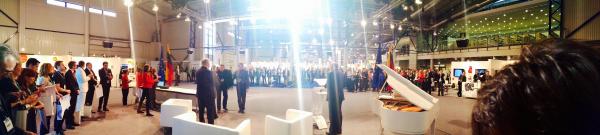
The MD-Paedigree booth at the ICT 2013 organized by the European Commision, won the prize for best booth at the event.
For more information about the MD-Paedigree project visit the website at http://www.md-paedigree.eu
The paper ‘Three-dimensional solid texture analysis in biomedical imaging: review and opportunities’ by Adrien Depeursinge, Antonio Foncubierta-Rodríguez, Dimitri Van de Ville and Henning Müller is now available at Medical Image Analysis:
http://www.sciencedirect.com/science/article/pii/S1361841513001497
Three–dimensional computerized characterization of biomedical solid textures is key to large–scale and high–throughput screening of imaging data. Such data increasingly become available in the clinical and research environments with an ever increasing spatial resolution. In this text we exhaustively analyze the state–of–the–art in 3–D biomedical texture analysis to identify the specific needs of the application domains and extract promising trends in image processing algorithms. The geometrical properties of biomedical textures are studied both in their natural space and on digitized lattices. It is found that most of the tissue types have strong multi–scale directional properties, that are well captured by imaging protocols with high resolutions and spherical spatial transfer functions. The information modeled by the various image processing techniques is analyzed and visualized by displaying their 3–D texture primitives. We demonstrate that non–convolutional approaches are expected to provide best results when the size of structures are inferior to five voxels. For larger structures, it is shown that only multi–scale directional convolutional approaches that are non–separable allow for an unbiased modeling of 3–D biomedical textures. With the increase of high–resolution isotropic imaging protocols in clinical routine and research, these models are expected to best leverage the wealth of 3–D biomedical texture analysis in the future. Future research directions and opportunities are proposed to efficiently model personalized image–based phenotypes of normal biomedical tissue and its alterations. The integration of the clinical and genomic context is expected to better explain the intra class variation of healthy biomedical textures. Using texture synthesis, this provides the exciting opportunity to simulate and visualize texture atlases of normal ageing process and disease progression for enhanced treatment planning and clinical care management.
The Medgift group had a segment in the canal 9 Valais news for it’s mobile image upload app:
The 5th Khresmoi Newsletter is now on the website:
http://khresmoi.eu/assets/Newsletter/newsletter5-khresmoi.pdf
The MedGIFT group is mentioned in local media:
http://1815.ch/wallis/aktuell/philipp-oggier-erhaelt-internationale-anerkennung-117769.html
http://www.etudiants.ch/cms/news/lorsque-le-telephone-mobile-est-utile-a-la-medecine-20131002
Prof. Henning Müller has been awarded a travel grant to attent the brokerage event at ICT 2013. The event will take place on 7-8 November 2013 in Vilnius, Lithuania.
The funding is provided by the Idealist2014 http://www.ideal-ist.eu/ project to supprot the networking between Swiss and EU13*participants in project to support the networking between Swiss and EU13*participants in the new EU Framework Programme for Research and Innovation Horizon2020 http://ec.europa.eu/research/horizon2020/index_en.cfm
The MICCAI 2013 accepted paper ‘Epileptogenic Lesion Quantification in MRI using Contralateral 3D Texture Comparisons’ by Oscar Alfonso Jimenez del Toro, Antonio Foncubierta-Rodríguez, María Isabel Vargas Gómez, Henning Müller and Adrien Depeursinge was awarded with the MICCAI 2013 Student Travel Award.
More information about the award can be found at http://www.miccai2013.org/travel_award.pdf
Hesso’s mobile app for uploading patient photos from smartphones was reviewed in a text from Aunt Minni
The smartphone app can quickly add patient information, upload and annotate images, and share the images with other users of the application. They could also be exported to a patient record.
Khresmoi project has been described in the EUresearcher magazine on page 13.
The full publication can be read here.
The MedGIFT group was present at MedInfo 2013 with 2 posters, a Khresmoi demo and an oral presentation. For more information visit:
– http://publications.hevs.ch/index.php/publications/show/1392
– http://publications.hevs.ch/index.php/publications/show/1390
Two abstracts have been submitted to SPIE Medical Imaging 2014. The Conferences will take place in San Diego, USA the 15-20 February 2014.
The abstracts are related to Multi-organ Probability Maps in whole body MR images and Pulmonary Embolism detection in 4D Dual Energy CT.
Registration to participate in VISCERAL Benchmark 1 has opened. Links to an Specfication document and Registration website are available at Benchmark 1 page.
35 volumes from 5 modalities are in the VISCERAL training set. In these volumes, 478 manual segmentations of individual organs are available. All 35 volumes also have a number of landmarks manually placed. The following organs are annotated: Kidneys, spleen, liver, lungs, urinary bladder, rectus abdominis muscle, lumbar vertebra #1, thyroid gland, pancreas, psoas major muscles, gall bladder, sternum, aorta, trachea, and adrenal glands.
We have one paper accepted in the main MICCAI 2013 conference, and one paper accepted in MICCAI-MCV 2013 workshop (Medical Computer Vision: Large Data in Medical Imaging):
Epileptogenic Lesion Quantication in MRI Using Contralateral 3D Texture Comparisons, Oscar Alfonso Jiménez del Toro, Antonio Foncubierta-Rodriguez, María Isabel Vargas Gómez, Henning Müller, Adrien Depeursinge, MICCAI 2013, Nagoya, Japan.
2D-Based 3D Volume Retrieval Using Singular Value Decomposition of Detected Regions, Alba G. Seco de Herrera, Antonio Foncubierta-Rodríguez, Emanuele Schiavi, Henning Müller, MICCAI-MCV 2013, Nagoya, Japan.