The Image Biomarker Standardisation Initiative (IBSI) is proud to launch chapter 2, with the goal of standardizing computations of imaging filters in radiomics. You can find more details on our website.


Content-Based Image Retrieval
The Image Biomarker Standardisation Initiative (IBSI) is proud to launch chapter 2, with the goal of standardizing computations of imaging filters in radiomics. You can find more details on our website.
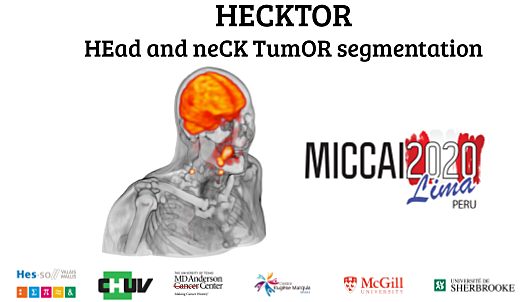
We are happy to announce the official start of the HECKTOR challenge (at MICCAI 2020) with the release of the training data. It comprises 201 cases of Head and Neck tumors with manual annotations on PET-CT images for segmentation of primary Gross Tumor Volumes.
The data can be downloaded from the aicrowd page.
A code for preprocessing the data, a baseline CNN and an example evaluation can be found on our github repository.
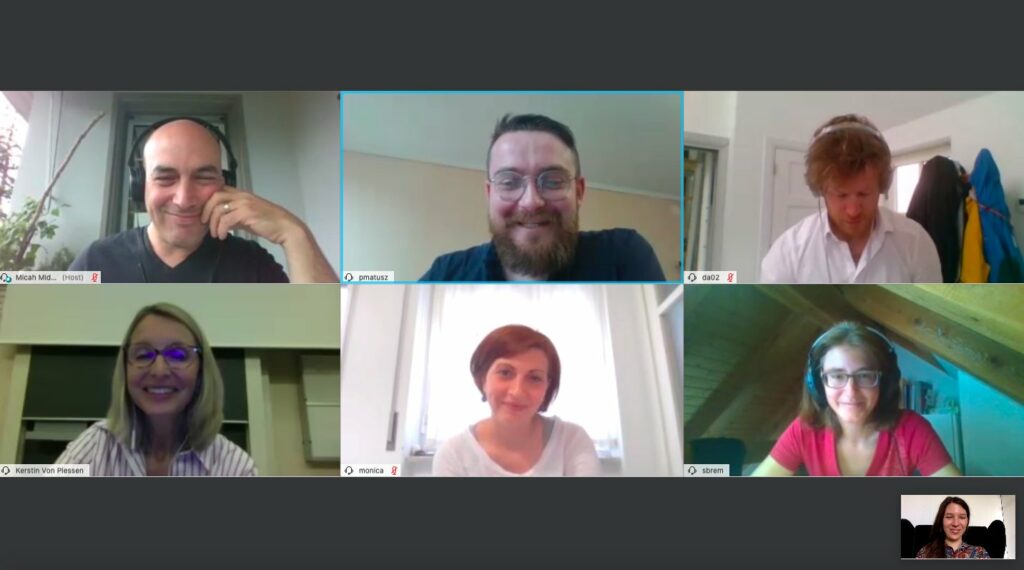
Congratulations to Dr. Nora Turoman who successfully defended her PhD thesis. Under the supervision of Paul Matusz (HES-SO/UNIL) and Micah M. Murray (UNIL), Nora studied the development of attentional control in real-world settings from childhood to adulthood.
Thanks to the EU project PROCESS, we’re now training convolutional neural networks on more than 7Tb of data. Our PhD student Mara Graziani answers questions and illustrates our software architecture in these videos.
Stay tuned for the code release in the coming months.
Prof. Henning Müller gave a presentation for the Digital Health Connect 2020 on Connecting visual information with semantics in histopathology image analysis for learning from weak labels.
How do you interpret your machine learning models?
Our third-year Ph.D. student Mara Graziani gave a virtual tutorial at IBM Research Zurich about applying interpretability techniques.
The recording was kindly shared on the Youtube channel of our school.
This talk provides an overview of the main interpretability approaches and a glimpse of our future research directions.
Our paper on the “Effect of movement type on the classification of electromyography data for the control of dexterous prosthetic hands” by Manfredo Atzori, Elisa Rosanda, Giorgio Pajardi, Franco Bassetto and Henning Müller has been accepted for presentation at the IEEE RAS/EMBS International Conference on Biomedical Robotics and Biomechatronics (BioRob 2020). The conference is currently planned to take place 29 Nov. – 2 Dec. 2020, in New York City, NY, USA.
Our Bridging Grant 2019 application has been accepted, in collaboration with the Research Center for Molecular and Cellular Imaging in Tehran University of Medical Sciences. This work will aim at the analysis of low-grade diffuse gliomas in MRI images. A large cohort of patients with brain cancer will be imaged with modern MRI scanners and analyzed using state of the art medical image analysis methods.
The HECKTOR challenge is coming at MICCAI 2020. Do not miss the first challenge on head & neck tumor segmentation in PET-CT images. Evaluate your cutting edge algorithm on 250 cases with high-quality annotations from five centers.

Our paper on Learning-based affine registration of histopathological images, by Marek Wodzinski and Henning Müller has been accepted and will be presented at WBIR 2020, the International Workshop on Biomedical Image Registration, Portoroz, Slovenia. Updates on the conference organization are coming soon.
Henning Müller will present his invited paper on Medical Image Retrieval: Applications and Resources and will give a keynote presentation at the ACM International Conference on Multimedia Retrieval (ICMR), 26-29th October 2020 in Dublin, Ireland.
Our paper on Automatic Segmentation of Head and Neck Tumors and Nodal Metastases in PET-CT has been accepted for presentation at the international conference on Medical Imaging with Deep Learning (MIDL). The conference will be fully virtual 6-8 July. In this paper, we developed a baseline for our MICCAI challenge (HECKTOR, more information to come).
Our paper entitled “Training a Deep Neural Networks for Small and Highly Heterogeneous MRI Datasets for Cancer Grading”, by Marek Wodzinski, Tommaso Banzato, Manfredo Atzori, Vincent Andrearczyk, Yashin Dicente Cid and Henning Müller, has been accepted for presentation at EMBC 2020, the International Conferences of the IEEE Engineering in Medicine and Biology Society in conjunction with the Conference of the Canadian Medical and Biological Engineering Society.
Our paper entitled “The Image Biomarker Standardization Initiative: Standardized Quantitative Radiomics for High-Throughput Image-based Phenotyping” has been accepted for publication in Radiology. It is the result of a large collaboration of researchers grouped under the name of Image Biomarker Standardization Initiative (IBSI), working towards standardizing the extraction of image biomarkers for radiomics studies.
Valentin Oreiller successfully passed his mid-thesis exam at the UNIL FBM quantitative biology doctoral school. Congratulations! His thesis is co-supervised by Prof. Adrien Depeursinge and Prof. John O. Prior.
The paper “Integrating radiomics into holomics for personalised oncology: from algorithms to bedside” by Roberto Gatta, Adrien Depeursinge, Osman Ratib, Olivier Michielin, and Antoine Leimgruber has been accepted for publication in European Radiology Experimental.
This work is the result of a collaboration between CHUV, HES-SO, and the Riviera-Chablais Hospital.
The full text is now available online at this link.
The paper on “Gaze, behavioral, and clinical data for phantom limbs after hand amputation from 15 amputees and 29 controls”, by Gianluca Saetta, Matteo Cognolato, Manfredo Atzori, Diego Faccio, Katia Giacomino, Anne-Gabrielle Mittaz Hager, Cesare Tiengo, Franco Bassetto, Henning Müller, Peter Brugger, has been accepted in Scientific Data and is now available online here.
The paper entitled “Gaze, visual, myoelectric, and inertial data of grasps for intelligent prosthetics“, by Matteo Cognolato, Arjan Gijsberts, Valentina Gregori, Gianluca Saetta, Katia Giacomino, Anne-Gabrielle Mittaz Hager, Andrea Gigli, Diego Faccio, Cesare Tiengo, Franco Bassetto, Barbara Caputo, Peter Brugger, Manfredo Atzori and Henning Müller has been accepted and published in Scientific Data, a journal from the publishers of Nature.
Don’t miss our new Medium publication page. You can find there technical tutorials, stories and insights on our research focus, and updates from conferences.
Some of our latest posts are:
How docker changed my life: deploying machine learning has never been this easy!

A simple formula for complex research: how to explain the role of AI to non- geeks

The prosthesis that everybody wants: working with amputees to design inexpensive prosthetic hands that work well
How to ‘crack the code’ of the developing brain?
